

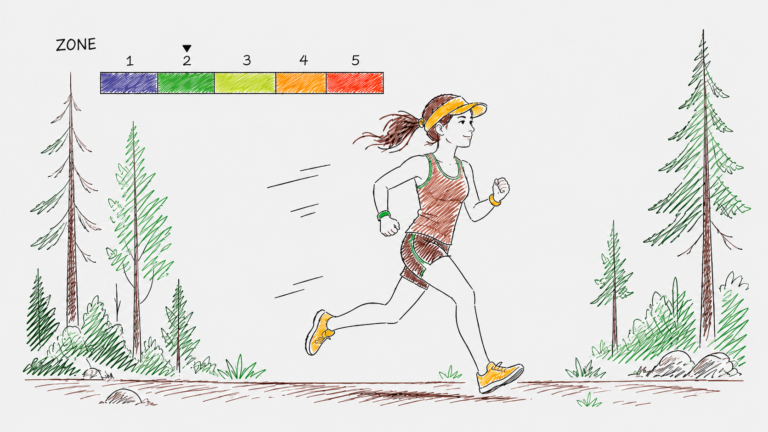
Slow running sounds easy.
You put on your shoes, start your watch, and tell yourself: today is not about speed. Today is a slow run. Stay in heart rate zone 2. Keep it light. Build endurance.
And then, a few minutes later, the watch beeps.
Too fast.
You slow down.
For a while, everything is fine. Then you get distracted. Your legs naturally speed up. Maybe someone passes you. Maybe the song in your headphones pushes your rhythm. Maybe your ego quietly whispers: You can go faster than this.
The watch beeps again.
Too fast.
Three running modes, three kinds of effort
In my training, I usually run in three modes.
The first is the slow run. The goal is to stay in zone 2, where the body builds aerobic endurance. It does not look impressive. It does not feel heroic. But it is the foundation.
The second is interval training: fast running, then walking or recovery, repeated several times. This is obviously hard. You know when you are pushing. You know when you are recovering.
The third is a longer run at a solid pace, which helps me prepare for a half-marathon. It is not a sprint, but it requires focus, strength, and the ability to keep going.
And this is the strange thing I discovered: the slow run is often the hardest one.
Not because it hurts the most. Intervals hurt more. Long runs require more time and stamina. But the slow run is hard in a different way. It requires constant self-control. You have to resist the temptation to speed up.
And I think work is very similar.
Work has heart rate zones too
At work, we also have different zones.
There is zone 5 work: deadlines, urgent delivery, last-minute presentations, crisis mode, the final push before something important. This kind of work is sometimes necessary. It can even feel exciting. There is adrenaline. There is focus. There is a clear finish line.
But we cannot live there all the time.
Then there is zone 2 work.
This is the work of building the pipeline. Preparing before things become urgent. Thinking clearly. Prioritizing. Improving quality. Creating systems. Having conversations early. Making better decisions before we are forced to make fast ones.
Zone 2 work is less dramatic.
Nobody applauds you for preventing chaos. Nobody says, “Great job thinking ahead before this became a disaster.” But this is often the work that creates the best long-term results.
The temptation to speed up
The hardest part of slow running is that the body keeps wanting to go faster.
The hardest part of good work is that the mind does the same.
We want to answer one more email. Finish one more task. Say yes to one more request. Cross one more thing from the to-do list.
For employees, slowing down may feel like not doing enough.
For entrepreneurs, slowing down may feel dangerous — as if every pause means lost opportunity.
Fast feels productive.
Busy feels responsible.
Urgent feels important.
But speed can be deceptive. We may be moving quickly without moving in the right direction. We may be crossing off tasks while avoiding the deeper work that would actually improve the result.
In running, if I turn every session into a fast run, I may feel strong for a while. But eventually, I will get tired, stop improving, or get injured.
At work, if every day becomes a sprint, something similar happens. Quality drops. Prioritization disappears. We react instead of thinking. We deliver, but we do not build.
Slow is not weak
Slow running is not lazy running.
It is disciplined running.
It is running with a purpose that is bigger than today’s pace.
And zone 2 work is not lazy work. It is not a lack of ambition. It is the kind of work that builds capacity, quality, and long-term results.
The slow run keeps teaching me the same lesson: not every form of progress feels like speed.
Sometimes the real training happens when we resist the urge to accelerate.
And maybe the same is true at work.
Sometimes the most productive thing we can do is slow down enough to think, choose, prepare, and build something that lasts.